Display
0 of 512 sampled inward chords fell below the 1.6 mm screening assumption.
These are sampled local rays, not minimum wall dimensions or a printable/not-printable verdict.
Inside the print lab · digital development
A miniature should keep its character. A keychain should make room for the ring that carries it. Here is the real work between a drawing and a future filament collectible.
This studio pass
Both keychain openings now measure approximately 5 × 5 mm at the central section.
Geometry screening
Earlier pass: two minis and two keychains, with 512 surface samples per model. The new beetle pass is below.
Physical samples
These are digital prototypes. Slicing, strength, likeness and real print samples remain pending.
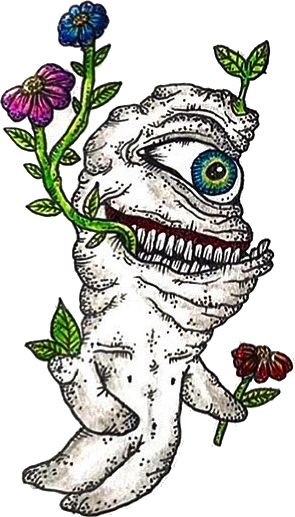
A little companion, carefully prepared
The joining neck has been shortened below the loop. The sampled central opening changed from 4.9 × 2.0 mm to 5.0 × 5.0 mm, leaving room for a key ring.
The top of the loop retains approximately 3.0 mm of material at this section. Pull strength and handling still need a physical test.
Fine surface features remain under review: 52 mini samples and 111 keychain samples fell below our candidate feature targets. These samples locate areas to inspect; they do not certify a minimum wall.

A little companion, carefully prepared
The joining neck has been shortened below the loop. The sampled central opening changed from 4.9 × 2.0 mm to 5.0 × 5.0 mm, leaving room for a key ring.
The top of the loop retains approximately 3.0 mm of material at this section. Pull strength and handling still need a physical test.
Fine surface features remain under review: 34 mini samples and 63 keychain samples fell below our candidate feature targets. These samples locate areas to inspect; they do not certify a minimum wall.
What the geometry tells us
Rose-colored dots mark low inward surface chords. They help us choose areas for inspection and refinement.
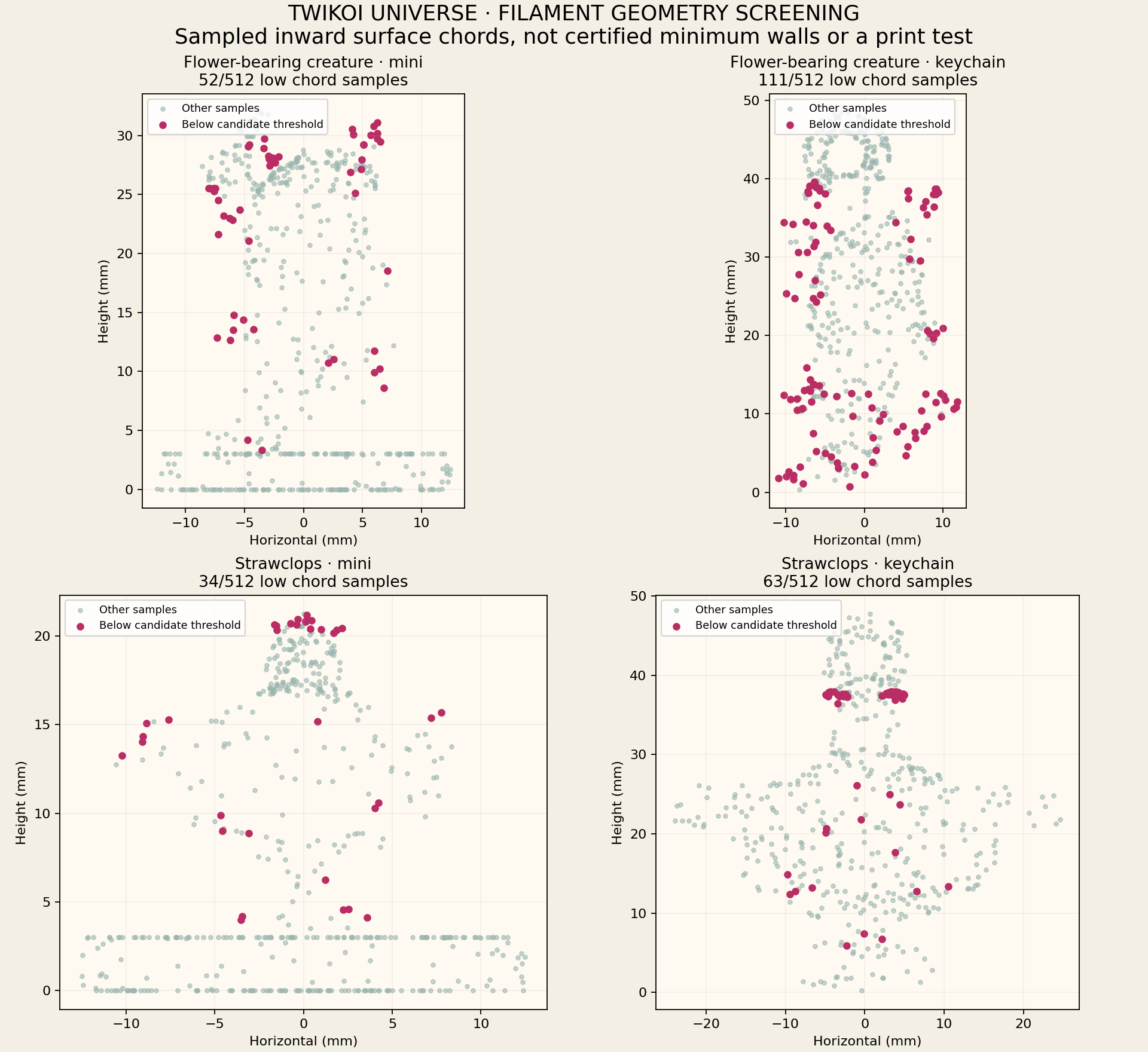
The mini footprints measure approximately 25 mm across. Our starting profile assumes a 0.4 mm nozzle and PLA; the installed nozzle and loaded material still need confirmation. The sampled feature targets are 1.6 mm for minis and 2.4 mm for keychains.
A sampled inward chord is a screening measurement. It can miss thin features and self intersections, and a grazing chord can be shorter than the usable wall. Closed geometry and a clear ring opening do not establish print quality or strength.
The next work is local feature refinement, slicer layer and support review, followed by supervised filament samples. Game rigs and high-detail likeness remain separate work.
Rotate the actual model versions →Each print version is an interpretation for artist review. Original art, source pixels and previous geometry revisions are preserved as the collection develops.
New in the relief studio · digital development
Two head illustrations, solid backings and original-art comparisons.
Explore the new relief work →New in the sculpture notebook
Actual relief turntables and a seated bear’s first four volumetric prototypes.
New in the construction notebook
Original art beside actual geometry. Two closed constructions; the large figure remains blocked. Likeness and physical tests pending.
Explore the new construction study →New from the flash sheet
Eight original drawings, a fictional story draft and four actual beetle model prototypes.
The beetle · read-only geometry notebook
The RTX 3090 checked 512 inward surface chords on each actual display, keychain and miniature file. Independent CPU rays matched; all three meshes stayed byte-for-byte unchanged.
0 of 512 sampled inward chords fell below the 1.6 mm screening assumption.
These are sampled local rays, not minimum wall dimensions or a printable/not-printable verdict.
258 of 512 sampled inward chords fell below the 2.4 mm screening assumption.
These are sampled local rays, not minimum wall dimensions or a printable/not-printable verdict.
217 of 512 sampled inward chords fell below the 1.6 mm screening assumption.
These are sampled local rays, not minimum wall dimensions or a printable/not-printable verdict.
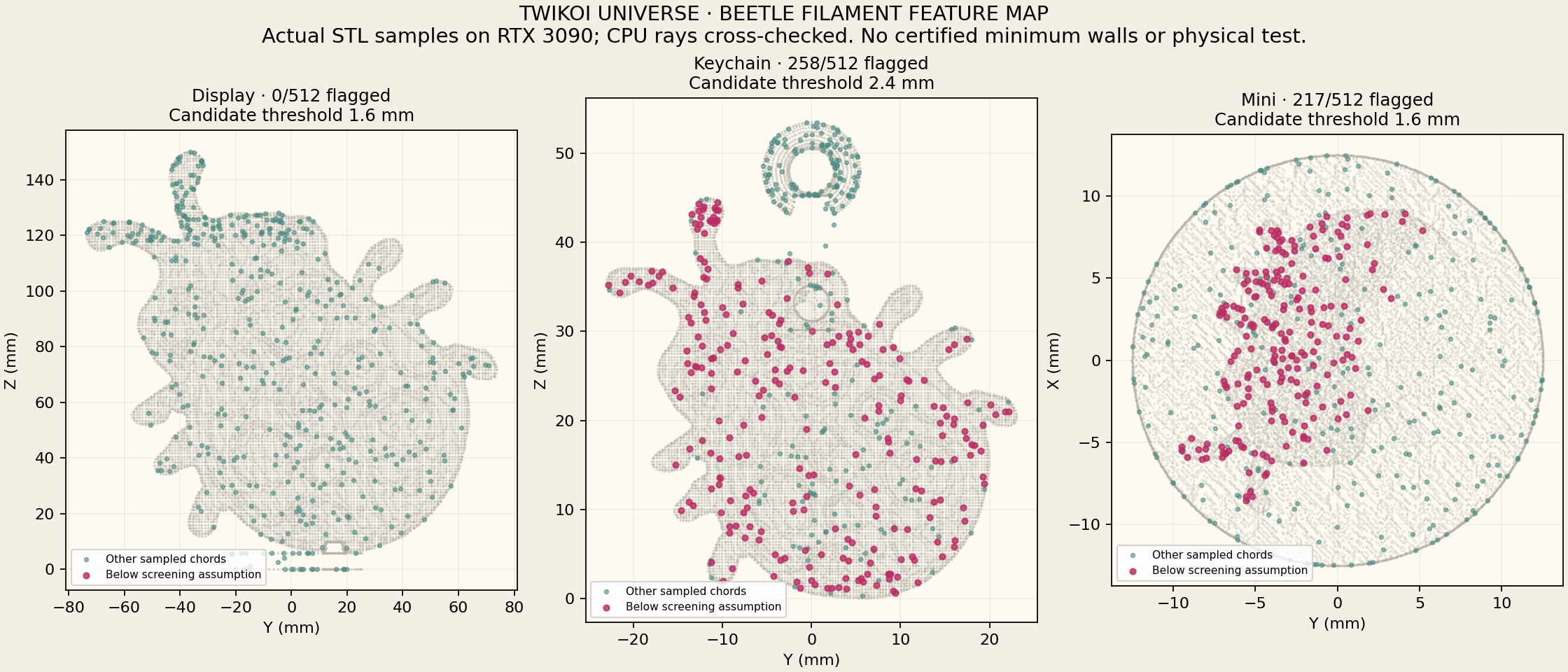
The keychain and miniature have many flagged samples. Fine limbs, antennae, surface ridges and attachment junctions need targeted inspection and refinement. Grazing rays can produce tiny chords; one small number alone does not establish a failed wall. The display's unflagged samples do not certify every feature.
Thresholds of 1.6 mm for display/mini and 2.4 mm for keychain are editable screening assumptions. Actual printer, nozzle, material, sliced layers, supports, strength, artist likeness and supervised physical samples remain pending.
New in the supported relief studio
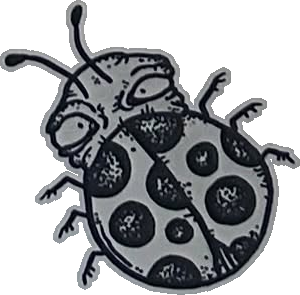
The beetle’s original art on a 4 mm-backed keychain and 25 mm tabletop token. Actual digital geometry; physical samples pending.
Explore the two relief alternatives →The supported beetle · fine-detail notebook
The same drawing becomes a larger keychain and a 25 mm token. Explore how their raised marks compare at three assumed extrusion widths.
0.45 mm assumed extrusion width. Actual nozzle, material and slicer settings remain unknown.
Pink: one-width disk review. Amber: additional two-width disk review. Blue: gap-closing review.
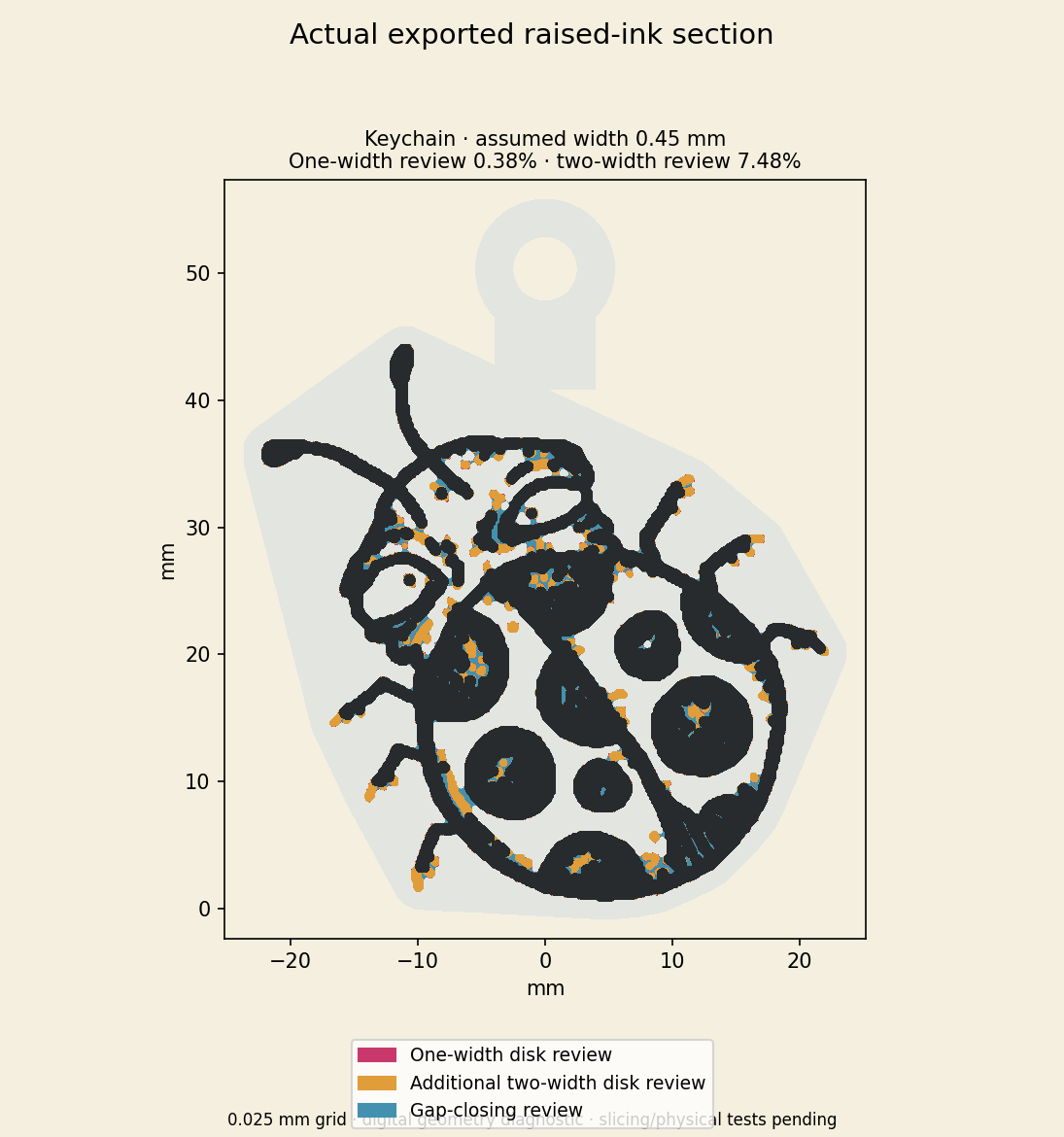
One-width disk review: 0.38% · Two-width disk review: 7.48%.
Colored cells are detail-review targets, not failed walls or a print verdict. Open the diagram for a closer look.
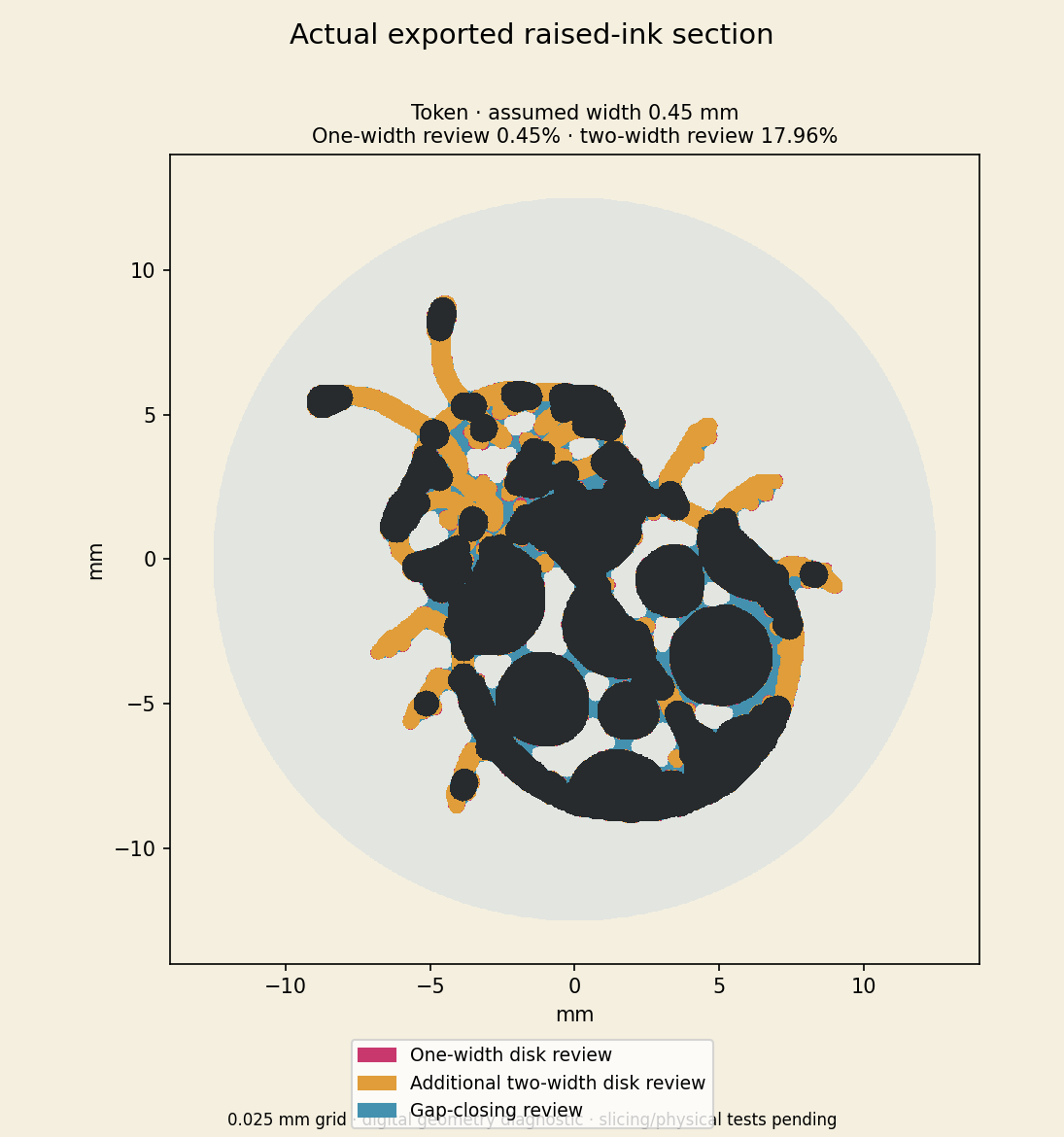
One-width disk review: 0.45% · Two-width disk review: 17.96%.
Colored cells are detail-review targets, not failed walls or a print verdict. Open the diagram for a closer look.
These marks sit on a continuous backing. The colored regions concern fine decorative detail; they do not measure the backing’s load-bearing strength. The smaller token has more areas that need review at a two-width target.
The widths are planning assumptions, not measured nozzle diameters or recommended printer settings. A fitted disk is a geometry check, not a generated slicer path. Gap-closing colors indicate where separation needs inspection; they do not predict actual filament spread.
Four sections come from the actual exported STL files. Screens at 0.05 and 0.025 mm grids matched the CPU in every mask comparison. These plots use the finer grid. Percentages count raised-ink raster cells outside fitted disks; they are not failure probabilities or certified minimum walls.
Small rounded corners and discrete grids affect the result. The full report retains both resolutions, their differences and all 60 calibration/actual-mask comparisons. Artist likeness, real extrusion settings, sliced layers, line/gap appearance, ring and neck stress, material behavior and supervised physical samples still need review.
New from the sculpture notebook
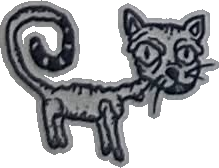
Actual cat prototypes beside the original drawing. Coarse likeness and physical preparation remain visible.
Explore the cat study →New in the raised-art studio
Original lines on a continuously backed keychain and 25 mm tabletop token. Explore the digital geometry and original-art appearances.
Visit the raised-art cat →The raised-art cat · fine-detail notebook
The same drawing becomes a larger keychain and a 25 mm token. Explore how their raised marks compare at three assumed extrusion widths.
0.45 mm assumed extrusion width. Actual nozzle, material and slicer settings remain unknown.
Pink: one-width disk review. Amber: additional two-width disk review. Blue: gap-closing review.
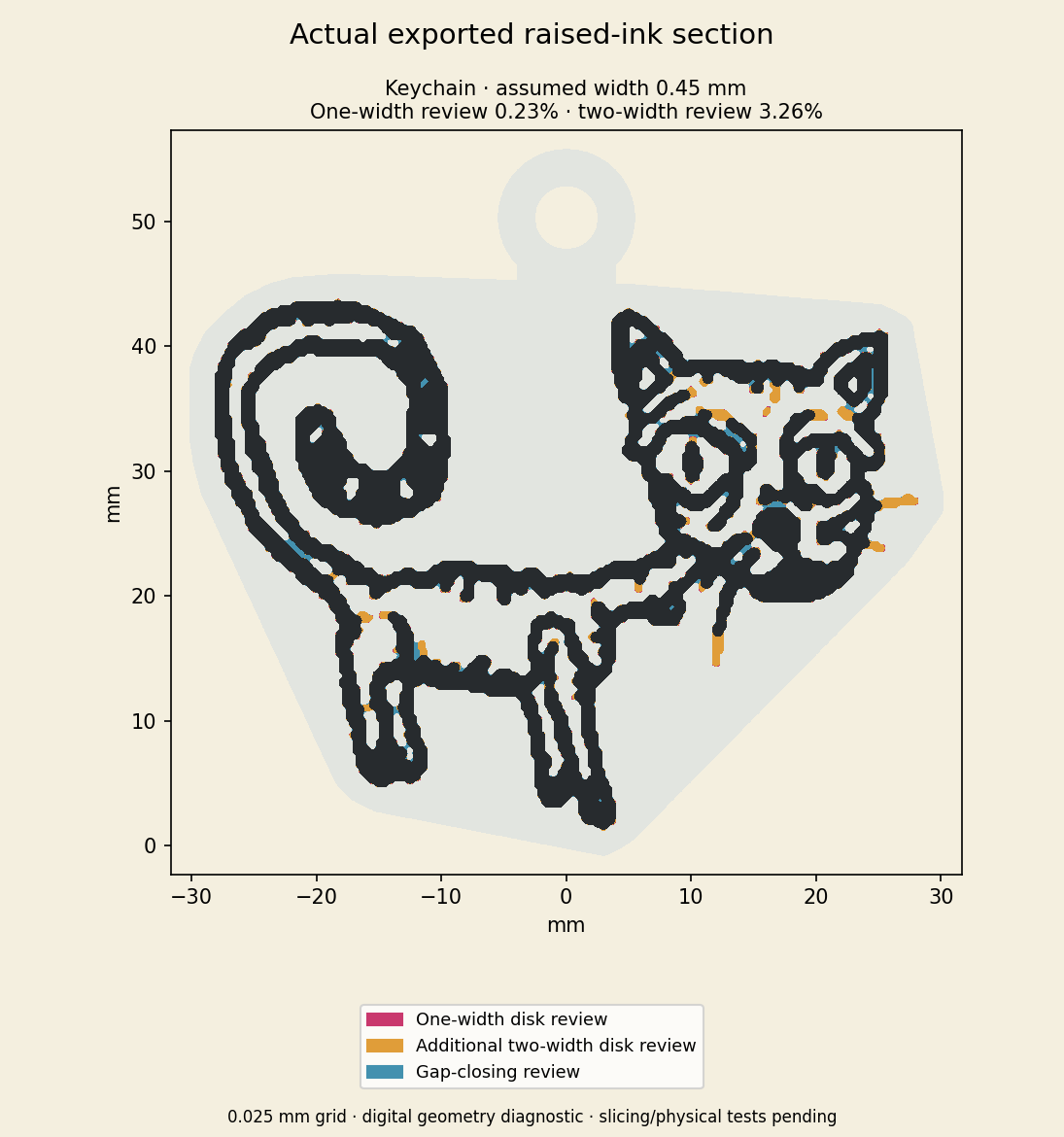
One-width disk review: 0.23% · Two-width disk review: 3.26%.
Colored cells are detail-review targets, not failed walls or a print verdict. Open the diagram for a closer look.
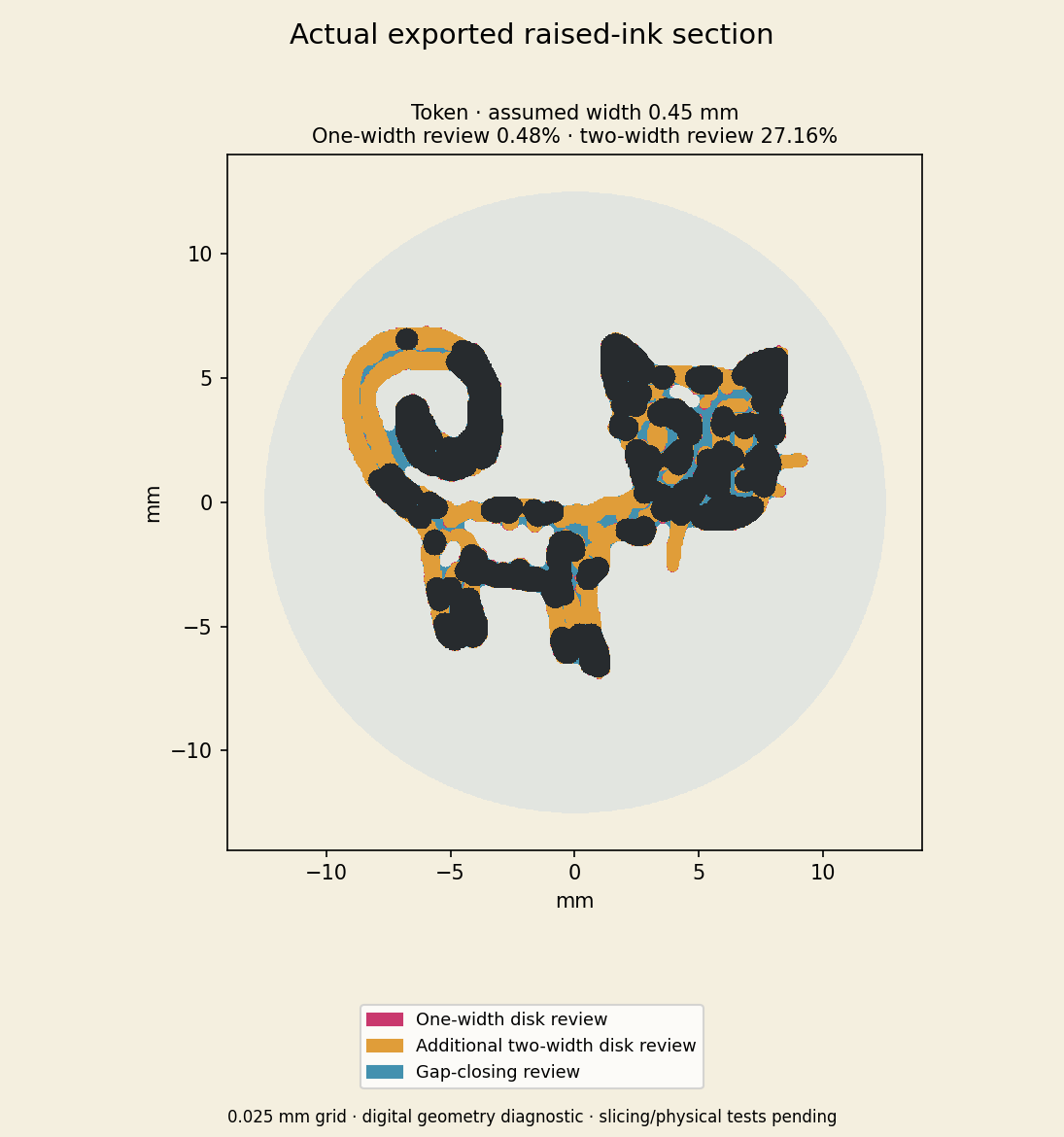
One-width disk review: 0.48% · Two-width disk review: 27.16%.
Colored cells are detail-review targets, not failed walls or a print verdict. Open the diagram for a closer look.
These marks sit on a continuous backing. The colored regions concern fine decorative detail; they do not measure the backing’s load-bearing strength. The smaller token has more areas that need review at a two-width target, especially around its eyes, curled tail, back and legs. The larger keychain is the first choice for detail-preserving print studies; slicing and physical validation remain pending.
The widths are planning assumptions, not measured nozzle diameters or recommended printer settings. A fitted disk is a geometry check, not a generated slicer path. Gap-closing colors indicate where separation needs inspection; they do not predict actual filament spread.
Four sections come from the actual exported STL files. Screens at 0.05 and 0.025 mm grids matched the CPU in every mask comparison. These plots use the finer grid. Percentages count raised-ink raster cells outside fitted disks; they are not failure probabilities or certified minimum walls.
Small rounded corners and discrete grids affect the result. The full report retains both resolutions, their differences and all 60 calibration/actual-mask comparisons. Artist likeness, real extrusion settings, sliced layers, line/gap appearance, ring and neck stress, material behavior and supervised physical samples still need review.
From the sculpture notebook
Mattea’s stitched rabbit meets four actual digital studies. Fine details, support design and physical testing remain in progress.
Explore the stitched rabbit →New in the raised-art studio
Original lines on a continuously backed keychain and 25 mm tabletop token. Explore the digital geometry and original-art appearances.
Visit the raised-art rabbit →The stitched rabbit · fine-detail notebook
The same drawing becomes a larger keychain and a 25 mm token. Explore how their raised marks compare at three assumed extrusion widths.
0.45 mm assumed extrusion width. Actual nozzle, material and slicer settings remain unknown.
Pink: one-width disk review. Amber: additional two-width disk review. Blue: gap-closing review.
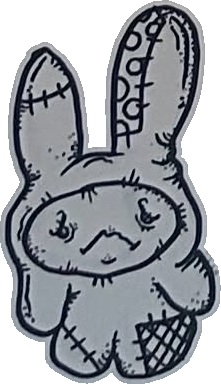
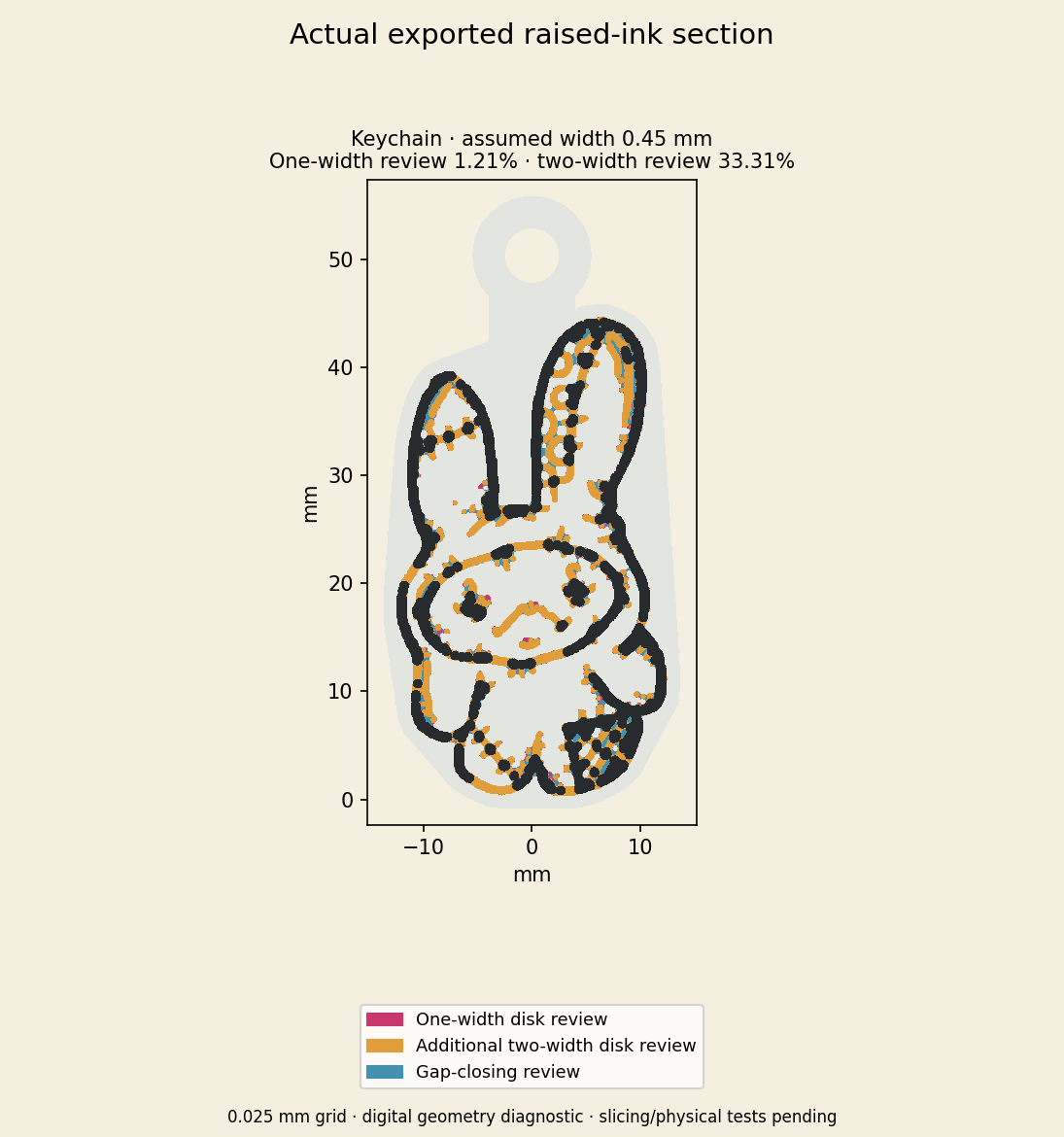
One-width disk review: 1.21% · Two-width disk review: 33.31%.
Colored cells are detail-review targets, not failed walls or a print verdict. Open the diagram for a closer look.
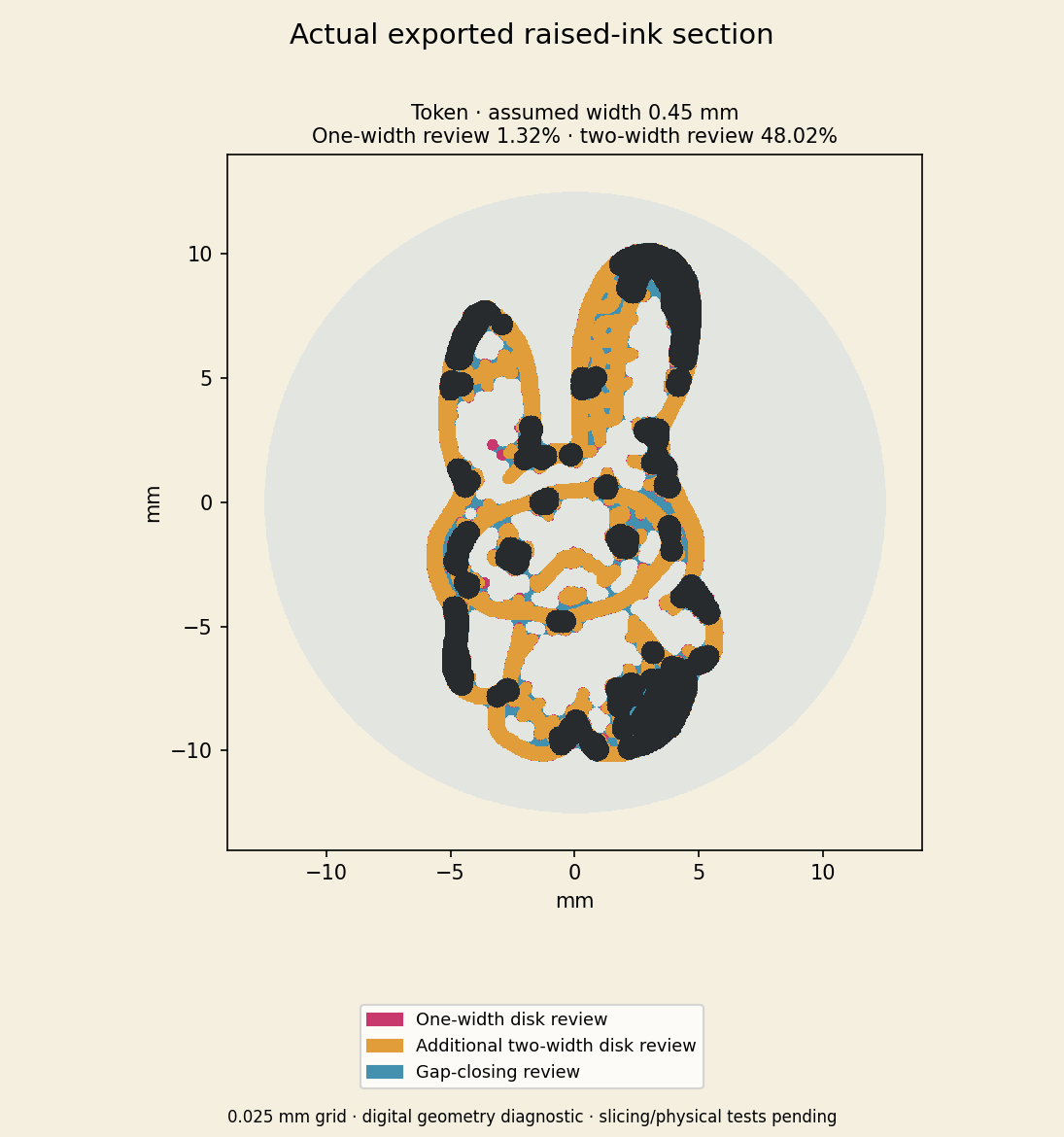
One-width disk review: 1.32% · Two-width disk review: 48.02%.
Colored cells are detail-review targets, not failed walls or a print verdict. Open the diagram for a closer look.
These marks sit on a continuous backing. The colored regions concern fine decorative detail; they do not measure the backing’s load-bearing strength. The smaller token has more areas that need review at a two-width target, especially around its eyes, ear stitches and crosshatched foot. The larger keychain is the first choice for detail-preserving print studies; slicing and physical validation remain pending.
The widths are planning assumptions, not measured nozzle diameters or recommended printer settings. A fitted disk is a geometry check, not a generated slicer path. Gap-closing colors indicate where separation needs inspection; they do not predict actual filament spread.
Four sections come from the actual exported STL files. Screens at 0.05 and 0.025 mm grids matched the CPU in every mask comparison. These plots use the finer grid. Percentages count raised-ink raster cells outside fitted disks; they are not failure probabilities or certified minimum walls.
Small rounded corners and discrete grids affect the result. The full report retains both resolutions, their differences and all 60 calibration/actual-mask comparisons. Artist likeness, real extrusion settings, sliced layers, line/gap appearance, ring and neck stress, material behavior and supervised physical samples still need review.
New in the sculpture notebook
Mattea’s curled grub meets four actual prototype paths. Likeness, detail and physical tests remain in progress.
Explore the curled grub →New in the sculpture notebook
Mattea’s antlered beetle meets four actual prototype paths. Likeness, detail and physical tests remain in progress.
Explore the antlered beetle →New in the sculpture notebook
Mattea’s seated patchwork creature meets four actual prototype paths. Likeness, detail and physical tests remain in progress.
Explore the seated patchwork creature →New in the raised-art studio
Original lines on a continuously backed keychain and 25 mm tabletop token. Explore the digital geometry and original-art appearances.
Visit the raised-art beetle →The antlered beetle · fine-detail notebook
The same drawing becomes a larger keychain and a 25 mm token. Explore how their raised marks compare at three assumed extrusion widths.
0.45 mm assumed extrusion width. Actual nozzle, material and slicer settings remain unknown.
Pink: one-width disk review. Amber: additional two-width disk review. Blue: gap-closing review.

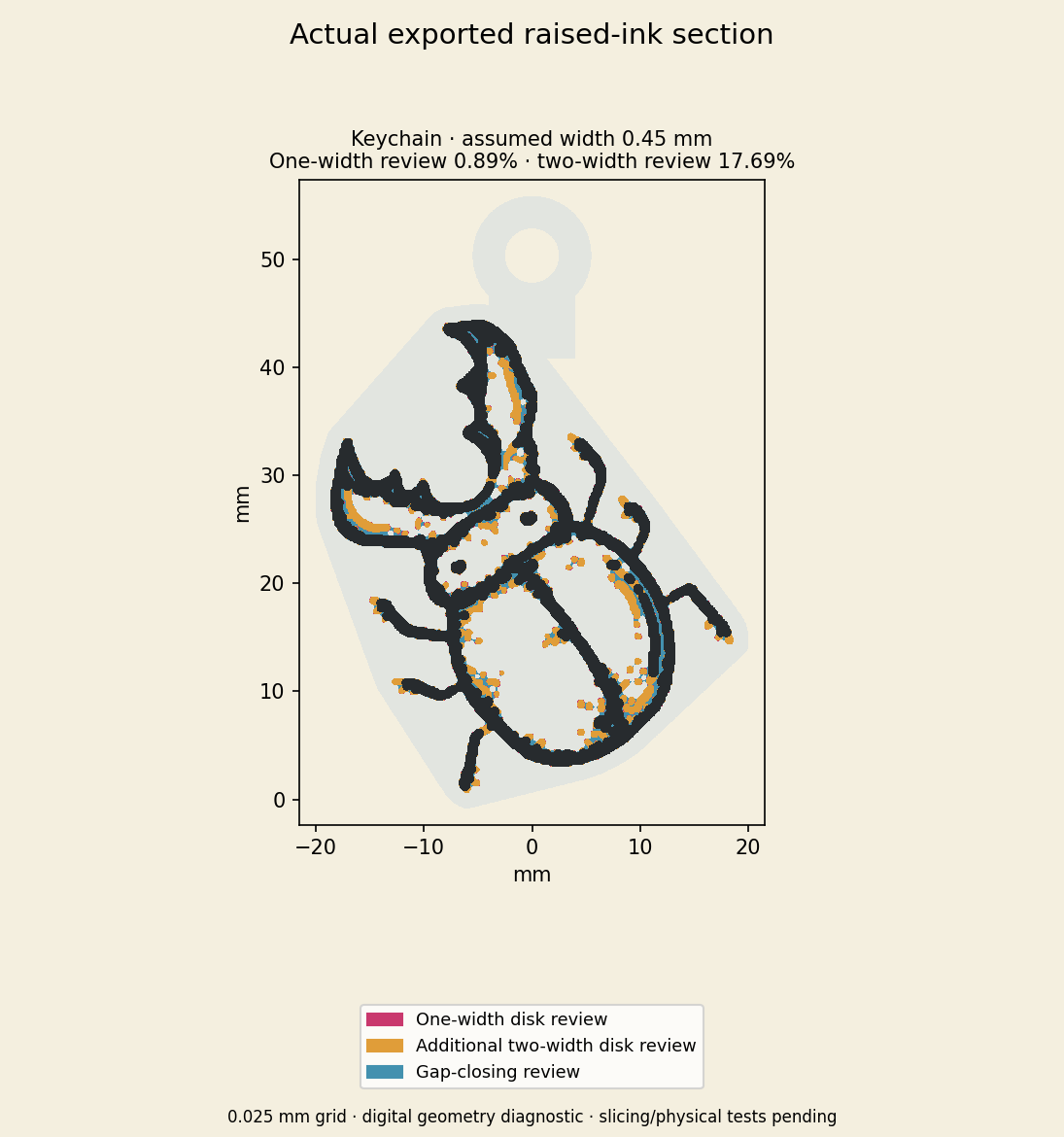
One-width disk review: 0.89% · Two-width disk review: 17.69%.
Colored cells are detail-review targets, not failed walls or a print verdict. Open the diagram for a closer look.
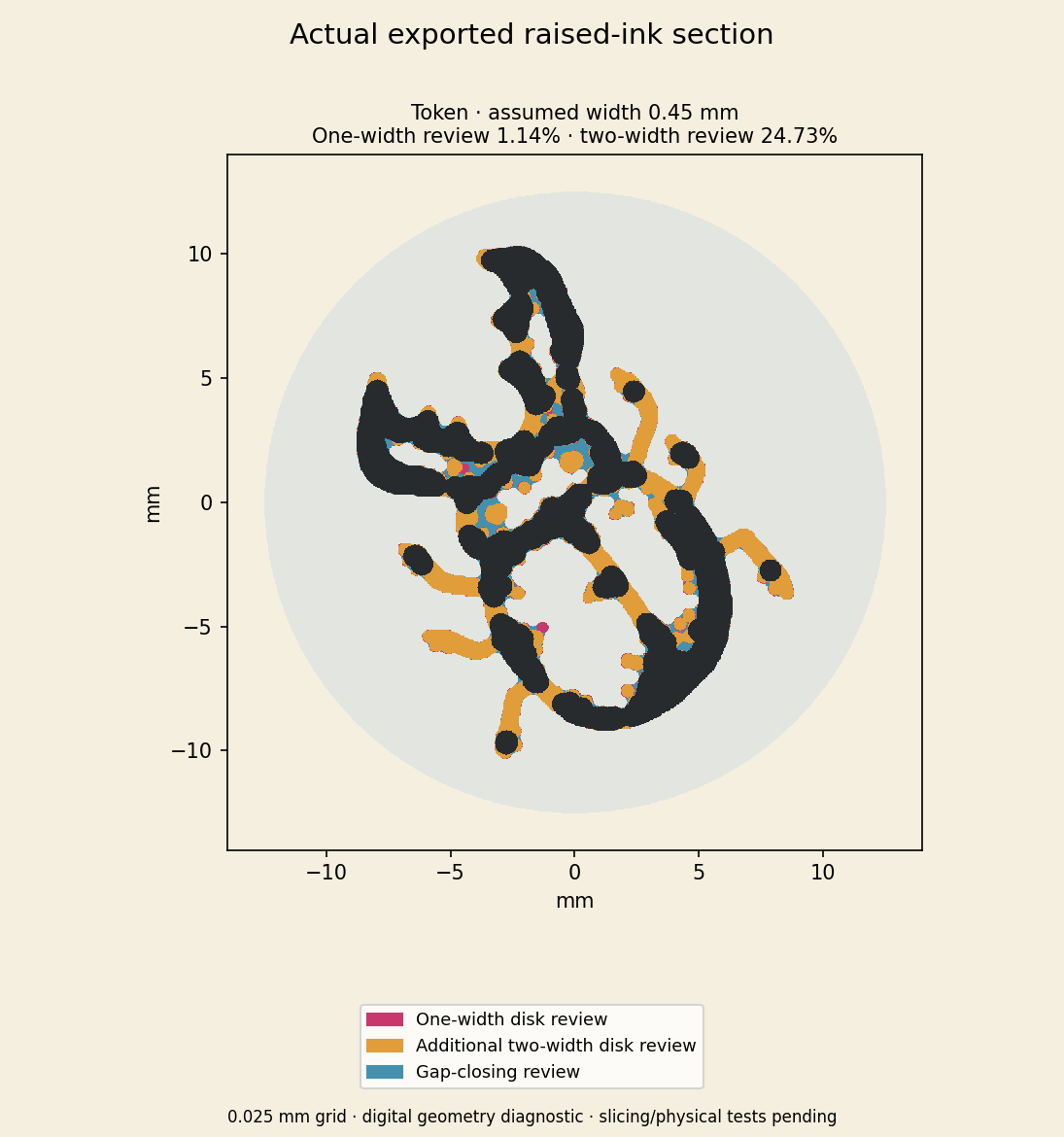
One-width disk review: 1.14% · Two-width disk review: 24.73%.
Colored cells are detail-review targets, not failed walls or a print verdict. Open the diagram for a closer look.
These marks sit on a continuous backing. The colored regions concern fine decorative detail; they do not measure the backing’s load-bearing strength. The smaller token has more areas that need review at a two-width target, especially around its wing hatching, mandible notches and leg outlines. The larger keychain is the first choice for detail-preserving print studies; slicing and physical validation remain pending.
The widths are planning assumptions, not measured nozzle diameters or recommended printer settings. A fitted disk is a geometry check, not a generated slicer path. Gap-closing colors indicate where separation needs inspection; they do not predict actual filament spread.
Four sections come from the actual exported STL files. Screens at 0.05 and 0.025 mm grids matched the CPU in every mask comparison. These plots use the finer grid. Percentages count raised-ink raster cells outside fitted disks; they are not failure probabilities or certified minimum walls.
Small rounded corners and discrete grids affect the result. The full report retains both resolutions, their differences and all 60 calibration/actual-mask comparisons. Artist likeness, real extrusion settings, sliced layers, line/gap appearance, ring and neck stress, material behavior and supervised physical samples still need review.